July 23, 2026 Reading Time: 2 minutes
Reading Time: 2 min read
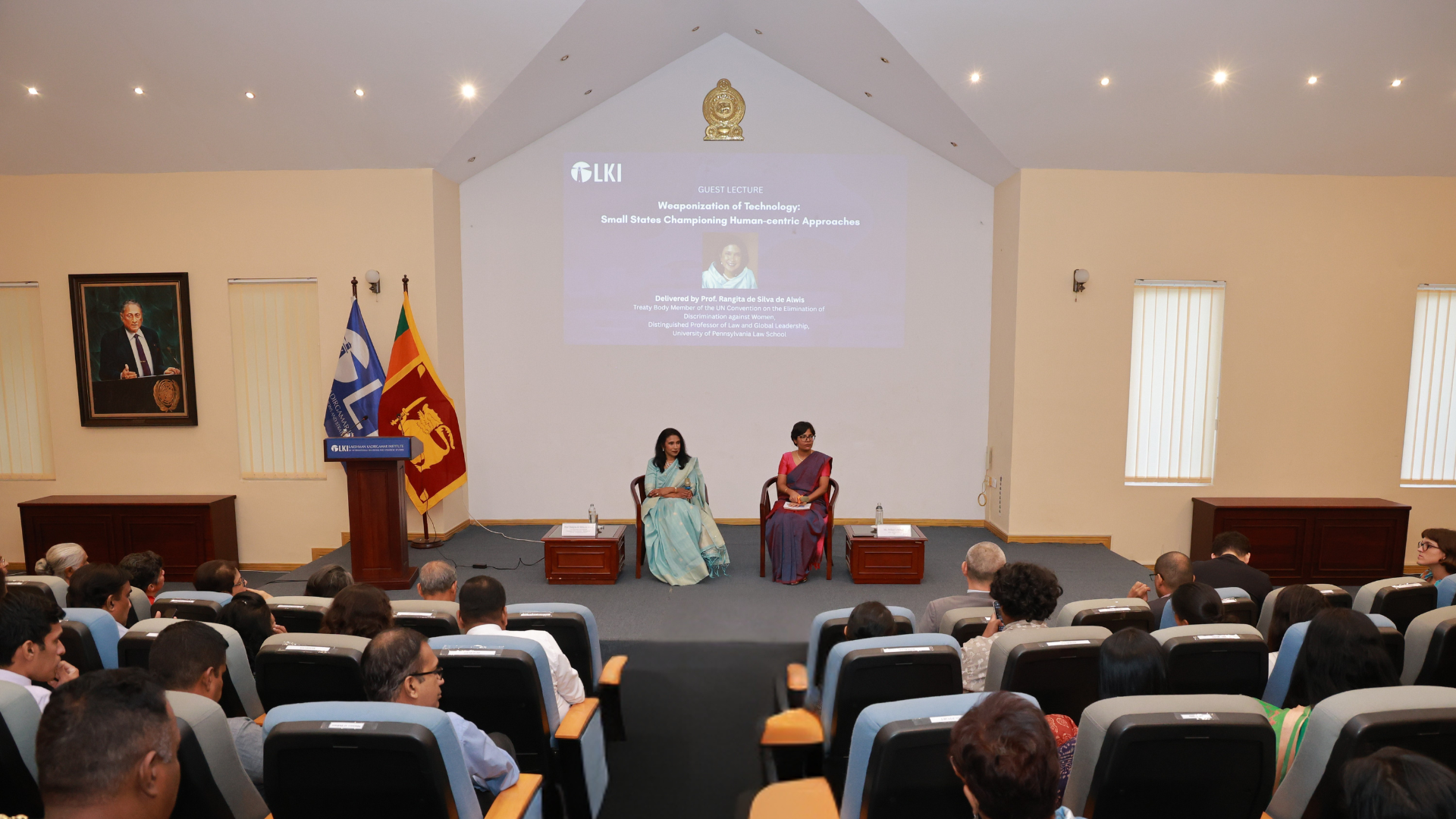
On 22 July 2026, the Lakshman Kadirgamar Institute of International Relations and Strategic Studies (LKIIRSS) hosted a guest lecture titled “Weaponization of Technology: Small States Championing Human-Centric Approaches.” The lecture was delivered by Prof. Rangita de Silva de Alwis, a member of the Committee on the Elimination of Discrimination against Women (CEDAW), and a globally recognised scholar in international law and human rights.
The lecture brought together members of the diplomatic community, government officials, academics, students, and representatives of think tanks and civil society to examine the rising influence of technology, international security, and global governance in dictating modern warfare.
Prof. de Silva de Alwis first reflected on the legacy of the late Lakshman Kadirgamar, highlighting his vision of peace as one founded on justice, dignity, and the protection of human rights. She argued that this vision remains relevant today as technological advances increasingly strengthen weapon capabilities, enhancing the scale of damage and duration of armed conflicts.
The lecture examined the growing use of artificial intelligence in warfare, with particular emphasis on Lethal Autonomous Weapons Systems (LAWS). Prof. de Silva de Alwis underscored the importance of maintaining meaningful human control over the deployment of force, noting that small states like Sri Lanka must preserve universal human values in a volatile geopolitical climate marked by competition for supremacy.
Highlighting the challenges AI-reliant warfare compounds, Professor de Silva de Alwis noted that algorithmic biases in autonomous weapon systems disproportionately harm marginalized groups, reinforcing existing gender, racial, and economic prejudices.
“Machine learning systems may rely on biased data, leading to the miscategorization of targets. These risks include the misidentification of women, children and other civilians,” she noted.
She also added that “historic gender, ethnic, and colonial biases are embedded into the design of algorithms and can be baked into autonomous weapons. Such encoded biases are heightened in military applications and run the risk of exposing women and children in particular to differential risks.”
Addressing the role of small states in the evolving global order, Prof. de Silva de Alwis observed that countries such as Sri Lanka can mold international norms by formulating responsible AI governance frameworks through coalitions with other small states.
She noted that small states possess the capacity to influence global discussions on emerging technologies by championing multilateral cooperation and advocating for the preservation of rules-based international governance within their blocs.
She also emphasized the significance of civil society participation in discourse surrounding LAWS, describing the steps taken by the ‘Campaign to Stop Killer Robots.’ The campaign is a coalition of 250 human rights organizations working to negotiate an international treaty that would prohibit the development and use of autonomous weapon systems unless for ethical purposes.
The lecture also explored current international efforts to impose checks and balances on autonomous weapons systems. These include discussions within the United Nations on developing a legally binding international governance framework regulating their provision and use.
The presentation was followed by an engaging Q&A session moderated by Senior Research Fellow of LKIIRSS, Ms. Nillasi Liyanage. During the session, participants exchanged views on the threats posed by artificial intelligence to international peace and security, as well as questions about the accountability gap in the use of weaponized technologies. They also contemplated the role of small states in ensuring that the weaponization of technology remains anchored in legality and ethics.
The event provided an important platform for informed dialogue on one of the defining policy challenges of the 21st century, reaffirming LKIIRSS’ commitment to fostering discussions on the intersection of technological advancements with international relations.
Read the full text of the guest lecture here.

24 Horton Place
Colombo 7
Sri Lanka
A think tank engaging in independent research of Sri Lanka’s international relations and strategic interests, to provide insights and recommendations that advance justice, peace, prosperity, and sustainability.