March 10, 2026 Reading Time: 2 minutes
Reading Time: 2 min read
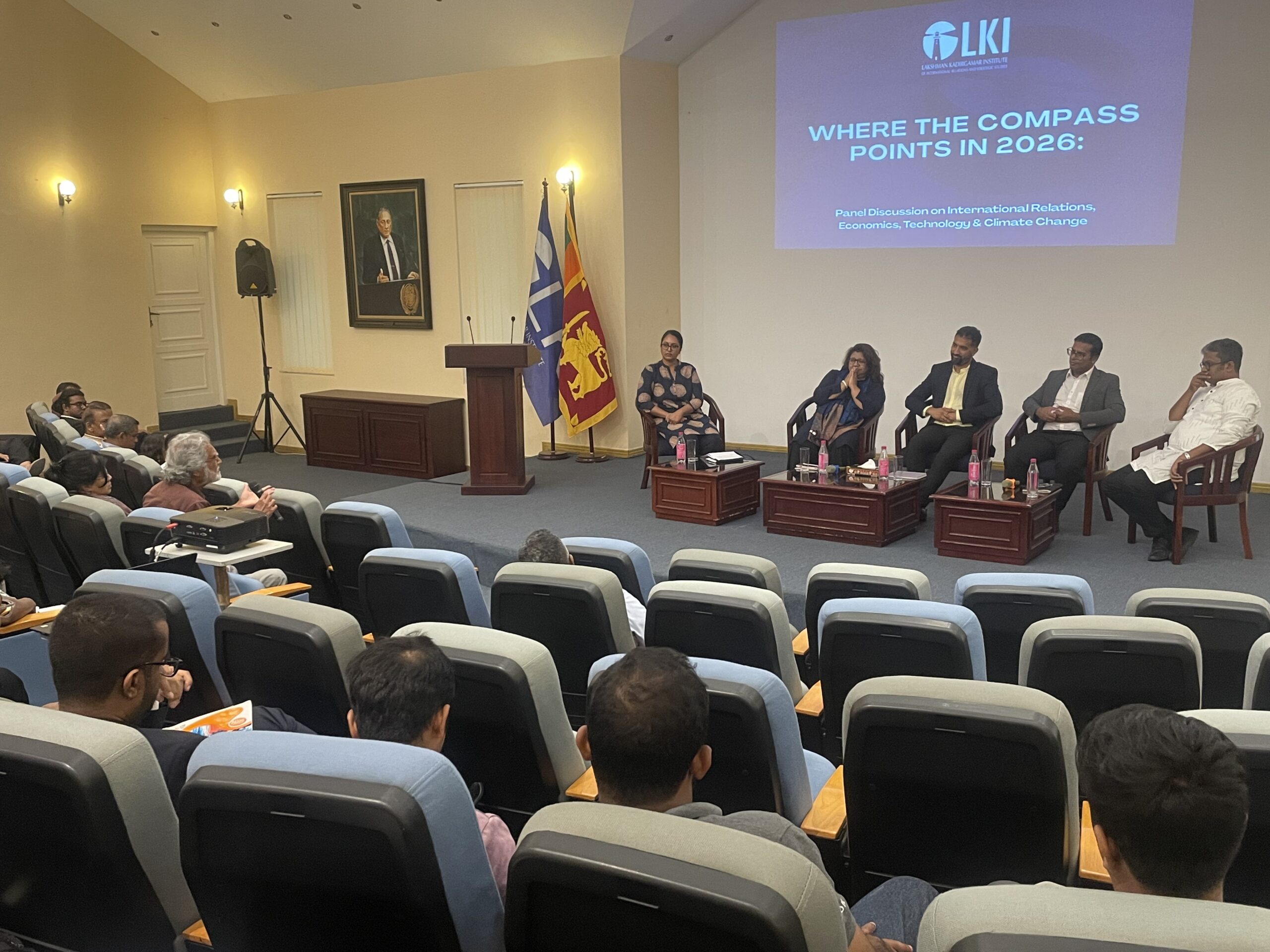
The Lakshman Kadirgamar Institute for International Relations and Strategic Studies (LKIIRSS) recently hosted a panel discussion titled “Where the Compass Points in 2026”, examining the rapidly evolving global landscape across International Relations, Economics, Technology, and Climate Change.
Held on Friday, 06 March 2026 from 4:00 PM onwards at the Lighthouse Auditorium, Lakshman Kadirgamar Institute, the event brought together scholars, policy practitioners, and students to deliberate on the direction of global politics and policy in an era of heightened uncertainty.
The discussion featured leading experts including Prof. Maneesha Wanasinghe-Pasqual of the International Relations Department at the University of Colombo, Omar Rajarathnam, Executive Director of Factum, economist Talal Rafi, and Kavindu Ediriweera of Slycan Trust Global. The discussion was moderated by Dr. Nishara Mendis, Executive Director of the LKIIRSS, who guided the conversation and facilitated a dynamic exchange of perspectives among the panelists on the evolving global landscape, for the year 2026.
The discussion came at a particularly critical moment. With the international system undergoing rapid transformation and geopolitical tensions reshaping global power dynamics, the stability of key economic and maritime routes and the broader rules-based order have increasingly come under strain.
For Sri Lanka, situated at a strategically significant crossroads in the Indian Ocean, such developments underscore the importance of carefully navigating an increasingly complex geopolitical environment. As a small state, Sri Lanka must continue to balance relationships, safeguard its economic and maritime interests, and engage thoughtfully with shifting global alignments while preserving strategic autonomy.
Against this backdrop, LKI recognizes the importance of fostering informed and coherent public discourse, particularly among the youth. As the world witnesses an increasingly complex and multipolar international system, the role of youth in sustaining thoughtful engagement with global affairs becomes ever more important. Platforms such as this discussion enable emerging scholars and practitioners to critically engage with unfolding developments and carry forward meaningful policy conversations.
For LKI, convening dialogues of this nature is more crucial now than ever. By bringing together diverse expertise and encouraging public-facing conversations on pressing global challenges, the institute continues to strengthen its position as a leading Sri Lankan think tank that bridges academia, diplomacy, and public policy.
Moreover, such discussions not only contribute to greater public understanding of international affairs but also reinforce LKI’s commitment to nurturing a generation capable of carrying the torch of informed discourse in an increasingly uncertain world.

24 Horton Place
Colombo 7
Sri Lanka
A think tank engaging in independent research of Sri Lanka’s international relations and strategic interests, to provide insights and recommendations that advance justice, peace, prosperity, and sustainability.