September 23, 2026 Reading Time: 4 minutes
Reading Time: 4 min read
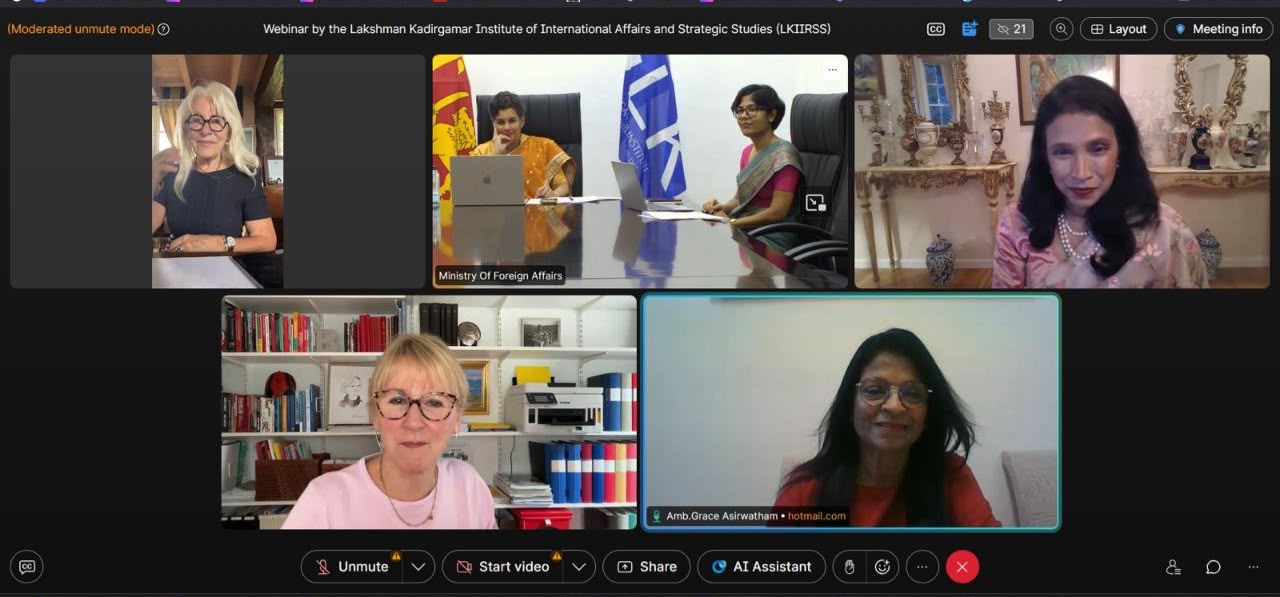
The Lakshman Kadiragamar Institute of International Relations and Strategic Studies (LKIIRSS) held a webinar titled ‘Feminist Diplomacy and Global Governance in an Age of Instability’ on 18th September 2026. The event featured trailblazers in feminist diplomacy and global governance, Ms. Margot Wallström, Professor Rangita de Silva de Alwis, and Dr. Nicole Ameline. Moderated by Ms. Manisha Gunasekera, Additional Secretary, UN and Human Rights, Ministry of Foreign Affairs, Foreign Employment and Tourism of Sri Lanka, the discussion centered on the transformative role of feminist diplomacy in addressing the multiplicity of challenges facing global governance in contemporary times.
Setting the stage for the panel discussion, Ms. Manisha Gunasekera highlighted the urgent need for feminist diplomacy in a geopolitically complex time where traditional multilateral organizations find themselves at multiple crossroads.
The first panelist was Ms. Margot Wallström, a former UN special representative on sexual violence in conflict, European Commissioner for the Environment, and the First Vice-President of the European Commission. Having spearheaded the 2014 adoption of the world’s first Feminist Foreign Policy by Sweden, as Sweden’s then Deputy Prime Minister and Minister of Foreign Affairs, Ms. Wallström, shared with participants the newest addition to her incredible list of accomplishments; the title of grandmother. This new responsibility, Ms. Wallström stated, has added an additional dimension to her understanding of the urgent need for a global adoption of a gender sensitive foreign policy- particularly in the role it plays in shaping the world for future generations. She noted that this far supersedes the realm of women’s issues, and is pertinent to the issue of peace and security for everyone regardless of gender.
Ms. Wallström observed that feminism, which she defines as the radical notion that women are human beings, is a highly practical framework which when incorporated into existing governing structures enable the legal right and freedom for women and girls to exist in the public sphere without fear of systemic, intra-personal, and interpersonal discrimination and abuse. She called for education and awareness on these matters, as it is imperative that future generations know that there are alternate and sustainable paradigms of security that are free of systemic gender based oppression.
The next panelist Professor Rangita de Silva de Alwis, Treaty Body member of the CEDAW and Distinguished Professor of Law & Global Leadership at University of Pennsylvania Law School, shed light on the emerging challenges facing Women, Peace and Security. As the architect of the first-ever addendum to General Recommendation 30 on women in conflict prevention, conflict, and post-conflict situations, she observed that the charter was built on the equal rights of women and men in nations small and large. Small power diplomacy by nations such as Sri Lanka, she recognized, is an integral part- rather than an afterthought- of multilateral feminist governance. She observed that the centering of diplomacy of this kind also pushes the need for global response to climate change, cyber attacks, as well as access to food and education to the forefront as it holds immense implications for those on the ground.
Professor de Silva de Alwis positioned feminist diplomacy as a bottom up diplomacy, where global governance is mobilized to respond to the needs of those most marginalized due to their intersectional identity. A feminist approach to global diplomacy, Professor De Silva de Alwis noted, is the primary strong hold against both the rise of the systemic erasure of women from public life and the weaponization of technology.
The third panelist, Dr. Nicole Ameline, Chair of the International Institute of Human Rights and Peace and Former Minister of Gender Equality in France, spoke on redefining women’s participation in decision-making as parity and equal exercise of power, drawing from the CEDAW Committee’s General Recommendation 40 (GR40) on reaching equal and inclusive representation of women in decision-making systems. Dr. Ameline, having led the CEDAW drafting group of the GR 40 during her tenure as Chairperson of the CEDAW Committee, noted how it is a direct response to the drastic underrepresentation of women in global leadership and peace negotiations. Globally, women make up roughly 25% to 26% of parliaments, with more and more elected women resigning due to various inequities in these environments. Thus, GR 40, she notes, is a legal framework for concrete operational roadmap that situates 50:50 parity as a starting point to address systemic inequity within governing structure.
Dr. Ameline stated the constant relegation of women to be in the sidelines of all decisions is a ‘scandal’ that cannot be accepted anymore, and called for a collective intelligence to drive systemic change. She proposed the creation of a digital network, made of new digital tools, that demonstrates a positive correlation between the number of women at the table and the likelihood for global peace and security. She noted that a digital feminist policy network would enable dynamic conversations across countries, involving both women and men across small and large nations in diplomatic negotiations and decision making.
The panel discussion was followed by an expert intervention by Ambassador Grace Asirwatham, Chairperson of the National Women’s Commission of Sri Lanka, former Secretary of the State Ministry for Foreign Affairs and diplomat of Sri Lanka. Ambassador Asirwatham brought perspectives from South Asia and Sri Lanka to the discussion, highlighting the need for closer inspection of the implications that diplomatic decision making has on women on the ground. Tying back to Professor de Silva de Alwis’s call for a bottom up diplomacy, Ambassador Asirwatham noted that the lack of progress in the lives of everyday women, despite decades of diplomatic meetings, is the result of an inability to translate formal conversations and commitments made on an global diplomacy level into practical outcomes in women’s lived experience. This gap, she noted, is not unique to Sri Lanka, as it is seen globally. She concluded that the success of global feminist diplomacy is to be measured by the tangible change that it has on the everyday lives of women on a national level.
The overall theme during the subsequent question and answer session revolved around responsibility and accountability within feminist diplomacy. In response to a question posed by Ms. Piyumani Ranasinghe, a Senior Research Fellow at the LKIIRSS, on the potential use of feminist diplomacy when navigating Sri Lanka’s approach to the mining and extraction industry, Professor de Silva de Alwis noted that we must first assess the environmental implications of mining and whether it is mutually beneficial to the people of Sri Lanka, in juxtaposition with the cobalt extraction industry in countries such as Congo. She saw the ‘vernacularization’ of feminist diplomacy into local languages also as a necessity.
Concluding the webinar, Senior Research Fellow of LKIIRSS, Ms. Nillasi Liyanage observed that the webinar highlighted how feminist diplomacy moves women beyond mere symbols in the international arena to becoming strategic actors who reshape global governance and its key concerns of peace and security.
Diplomatic missions including the Embassy of France, The High Commission of Canada, and the High Commission of New Zealand were represented at the webinar. The online audience of the webinar was composed of academics, researchers, members of international organizations, civil society and INGOs, students and members of the military.
Watch the recording here: https://youtu.be/6dHTcPASeXs?si=I63vMJifBARpsA7C

24 Horton Place
Colombo 7
Sri Lanka
A think tank engaging in independent research of Sri Lanka’s international relations and strategic interests, to provide insights and recommendations that advance justice, peace, prosperity, and sustainability.