October 7, 2026 Reading Time: 3 minutes
Reading Time: 3 min read
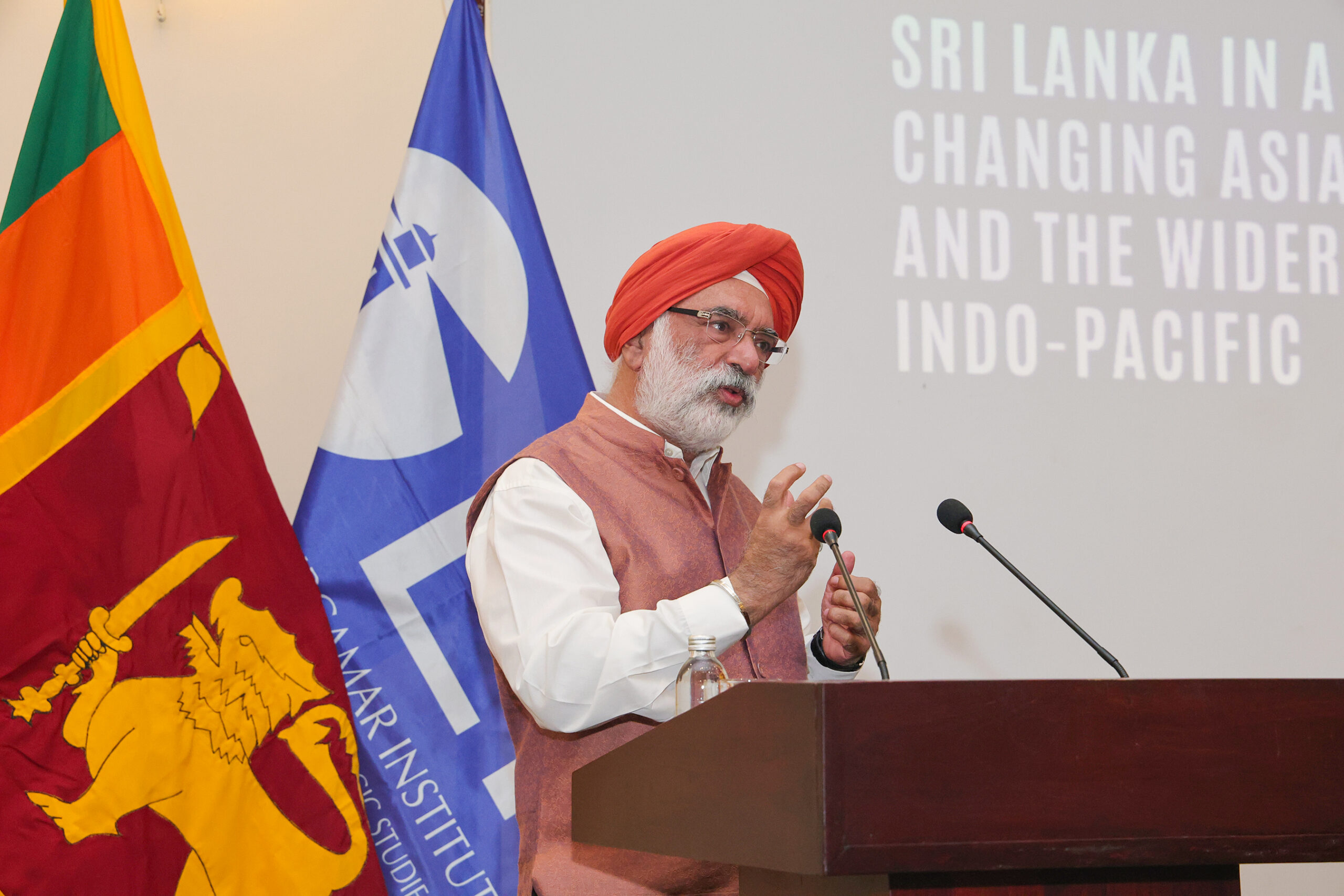
The Lakshman Kadirgamar Institute of International Relations and Strategic Studies (LKI) hosted a special guest lecture titled “Durian Flavour in Colombo: Sri Lanka in a Changing Asia and the Wider Indo-Pacific”, featuring Ambassador Gurjit Singh, former Ambassador of India to Germany, Indonesia, ASEAN and the African Union.
Ambassador Singh’s engagement with the Institute marked his return to Sri Lanka after 35 years. He previously served in Sri Lanka from 1988 to 1991, a significant period in the country’s domestic and international affairs. The event brought together members of the diplomatic corps, senior government officials, representatives of government and military institutions, academics, researchers and students. Members of the LKI Board of Management present at the event included Dr. Ranga Kalansooriya, Dr. Kamal Tennakoon and Mr. Imran Furkan.
The lecture drew on Ambassador Singh’s latest book, The Durian Flavour: India and ASEAN after a Decade of the Act East Policy, published in February 2026. The discussion examined the evolving relationship between India and ASEAN and its wider implications for regional cooperation, economic engagement and the Indo-Pacific.
In his remarks, Ambassador Singh emphasised the importance of building contemporary regional relationships around tangible benefits for people, rather than viewing foreign policy solely through the lens of government-to-government relations. He highlighted impact investing, the green economy and trilateral cooperation as areas through which countries could strengthen practical cooperation and generate broader economic benefits. He also stressed the importance of people-led approaches to regional engagement.
Reflecting on the changing Asian regional architecture, Ambassador Singh discussed the evolution of ASEAN and the opportunities and choices facing countries seeking deeper engagement with the region. He addressed Sri Lanka’s position as an ASEAN Dialogue Partner and raised questions concerning the country’s potential engagement with the Regional Comprehensive Economic Partnership (RCEP), including the possible benefits and implications of greater integration with regional supply chains.
The discussion also considered Sri Lanka’s potential to utilise its geographical position and maritime connectivity to contribute to regional cooperation. In this context, Ambassador Singh identified the Indian Ocean Rim Association (IORA) as one avenue through which Sri Lanka could strengthen its bridge-building role within the wider Indo-Pacific. He further emphasised that regional organisations require the participation and shared contribution of their members, rather than placing the responsibility for regional cooperation on any single country.
In introductory remarks preceding the lecture, Ms. Piyumani Ranasinghe, Senior Research Fellow at LKI, situated the discussion within LKI’s ongoing research on Sri Lanka’s strategic agency in the Indo-Pacific. She highlighted the distinction between Sri Lanka’s strategic importance and strategic agency, noting that geographical significance does not automatically translate into the capacity to shape regional outcomes. She emphasised that strategic agency depends on institutions, policy, negotiation, regulation and the capacity to shape the terms of Sri Lanka’s engagement with the wider region.
Drawing on Sri Lanka’s engagement with India, ASEAN, BIMSTEC, IORA, the ASEAN Regional Forum and the Shanghai Cooperation Organisation, Ms. Ranasinghe highlighted the diversification of Sri Lanka’s regional engagements. She argued that the key question for Sri Lanka is not simply whether it participates in regional institutions, but whether such participation enables the country to contribute to regional agendas, negotiate the terms of cooperation, develop regional initiatives and participate meaningfully in shaping regional rules.
The ensuing discussion explored the practical meaning of strategic autonomy for Sri Lanka, including how the country can maintain diversified partnerships while safeguarding its capacity to pursue its national interests. Questions from the audience also addressed India – Sri Lanka economic relations, including the Economic and Technology Cooperation Agreement (ETCA), RCEP, regional organisations such as SAARC and BIMSTEC, Sri Lanka’s relationship with India, and the role of people-to-people connections in strengthening regional relations.
The programme also featured the presentation of Ambassador Singh’s The Durian Flavour: India and ASEAN after a Decade of the Act East Policy and Vignettes from Nehru, edited by Lakhan Lal Mehrotra, as well as the presentation of The Youthquake by Dr. Ranga Kalansooriya, Member of the LKI Board of Management.
The event was moderated by Ms. Piyumani Ranasinghe, Senior Research Fellow at LKI, and concluded with an interactive discussion with Ambassador Singh and the audience. The programme provided an opportunity to reflect on Sri Lanka’s evolving place within Asia and the wider Indo-Pacific, and on how the country can translate its historical connections, geographical position and regional relationships into meaningful strategic agency.
The event formed part of LKI’s continuing efforts to facilitate informed dialogue on Sri Lanka’s foreign policy choices, regional engagement and strategic interests in a rapidly evolving Asian and Indo-Pacific environment.

24 Horton Place
Colombo 7
Sri Lanka
A think tank engaging in independent research of Sri Lanka’s international relations and strategic interests, to provide insights and recommendations that advance justice, peace, prosperity, and sustainability.