February 24, 2026 Reading Time: 2 minutes
Reading Time: 2 min read
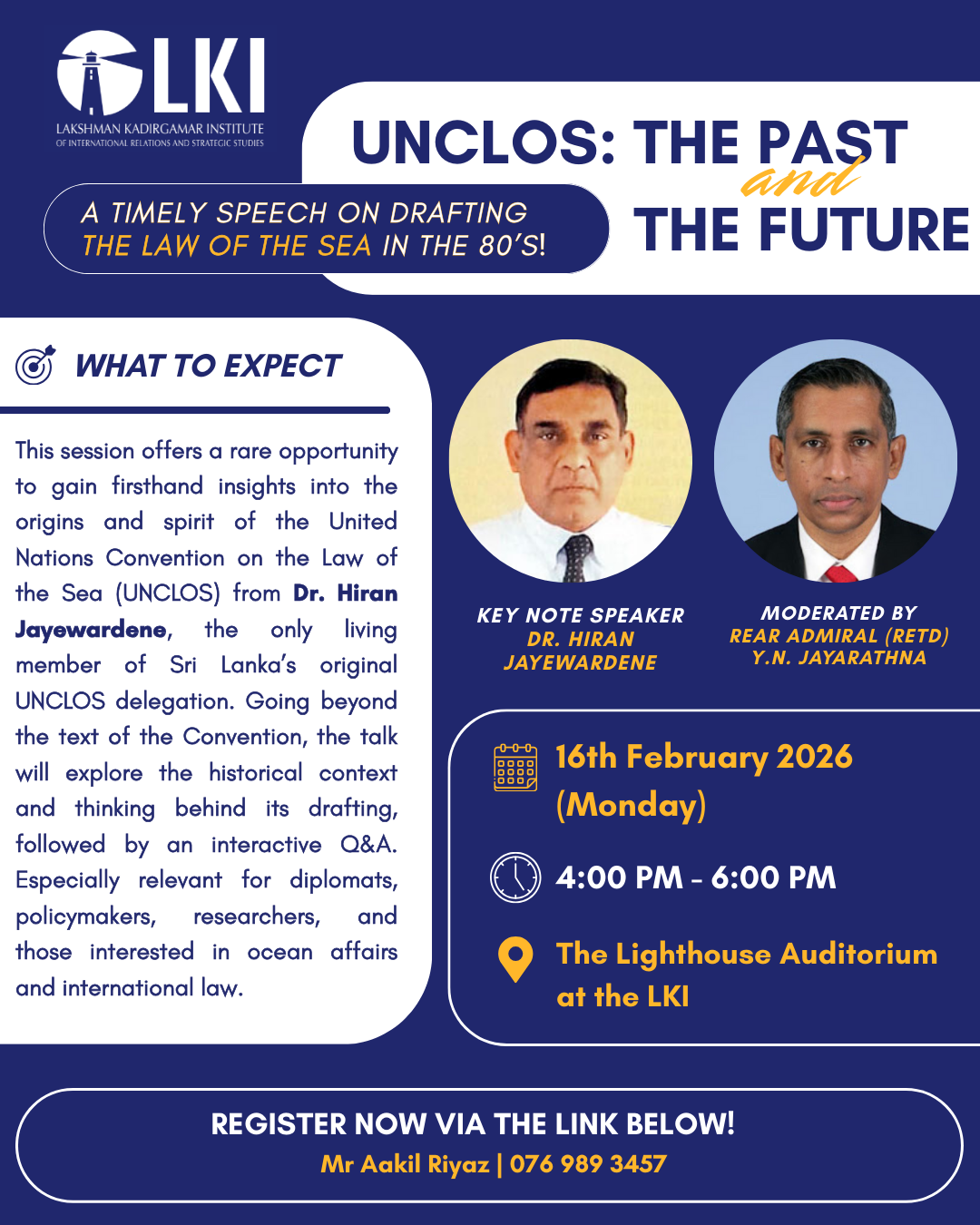
On the 16th of February 2026, the Lakshman Kadirgamar Institute for International Relations & Strategic Studies (LKIIRSS) hosted a discussion titled ‘UNCLOS: The Past & The Future’ with Dr. Hiran Jayewardene as the key speaker.
Dr. Hiran Jayewardene is the last surviving member of Sri Lanka’s delegation to the Law of the Sea Conference, and the session was designed to deliver his insight into the formulation of UNCLOS and the Statement of Understanding (SOU). The event was moderated by Rear Admiral (Retd.) Y. N. Jayarathna, and the event drew a large crowd at the Lighthouse Auditorium, where a rare and reflective account of Sri Lanka’s involvement in the process of making UNCLOS was shared.
Drawing on his personal experiences as a member of Sri Lanka’s delegation to the Law of the Sea Conference in the 1980s, Dr. Jayewardene traced how a small island state navigated one of the most technically complex diplomatic processes of the twentieth century. He spoke about the initial knowledge gaps faced by developing states, the deliberate efforts undertaken to bridge them, and the intellectual discipline required to engage meaningfully within the UN negotiation system. In doing so, he underscored how strategic clarity enabled Sri Lanka to establish its voice and credibility within a highly competitive multilateral arena.
The core focus of the discussion was on the drafting of the Statement of Understanding (SoU), which he described as a pivotal instrument in bridging scientific realities with treaty obligations, particularly for smaller states who were to be deprived of benefits from the established formulae lines. Dr. Hiran Jayewardene recalled how India and the USSR supported the drafting of the SOU, along with the USA’s support in obtaining much of the oceanographic and marine geological data, based on extensive research conducted by them at that time.
Dr. Hiran’s reflections resonate strongly in today’s context, where UNCLOS continues to underpin debates on maritime jurisdiction, resource governance, and ocean sustainability. Furthermore, Dr. Hiran Jayewardene recalled how then Foreign Minister A. C. S. Hameed played a pivotal role towards the conclusion of the conference.
The discussion was further enriched by the moderation of Rear Admiral (Retd.) Y. N. Jayarathna, alongside interventions from Dr. M. A. M. Hakeem, Faculty of Law, University of Colombo, whose PhD thesis was on the SOU, and Dr. Wijyayananda, as the marine geologist in the 1980s who recalled how he spent time onboard foreign research vessels for seabed surveys as part of international research excursions.
Together, the exchange evolved into a forward-looking dialogue, linking historical negotiation experiences with contemporary challenges and reaffirming the enduring relevance of UNCLOS knowledge for Sri Lanka’s present and future maritime policy discourse. The audience engaged the speaker with probing questions on UNCLOS and the SOU, and Dr. Hiran Jayewardene was able to recall many instances of engaging hard-core issues at the conference, and managing the scientific, legal, and oceanographic issues that cropped up during the negotiations.
The LKI, as a premier think tank in the country, actively engaged in addressing awareness deficiencies on strategic matters with regard to the island andpride in engaging Dr. Hiran Jayewardene for this unique discussion forum.

24 Horton Place
Colombo 7
Sri Lanka
A think tank engaging in independent research of Sri Lanka’s international relations and strategic interests, to provide insights and recommendations that advance justice, peace, prosperity, and sustainability.