December 9, 2025 Reading Time: 2 minutes
Reading Time: 2 min read
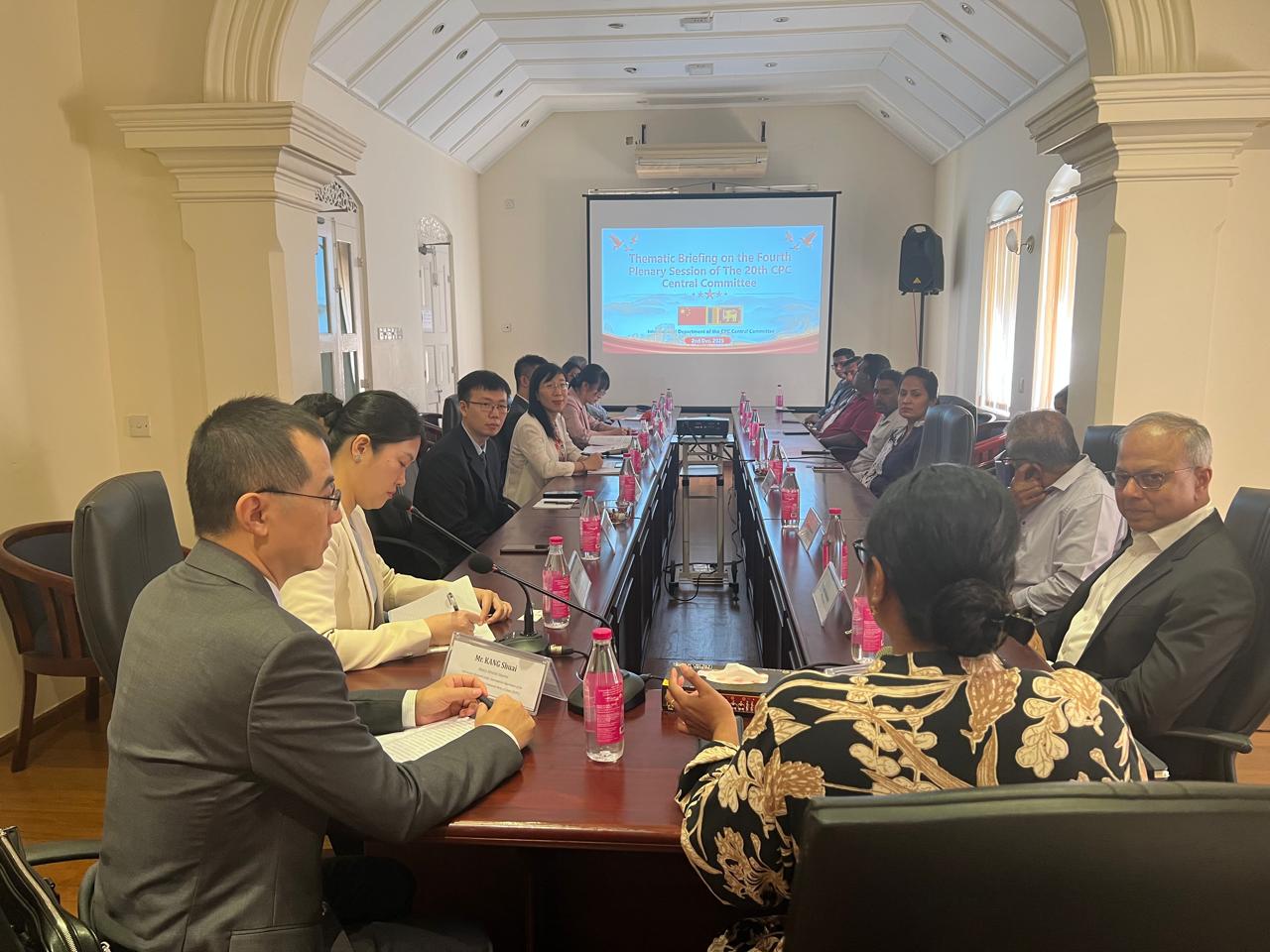
On Tuesday, 2 December 2025, the Lakshman Kadirgamar Institute of International Relations and Strategic Studies (LKI) hosted a dialogue with a delegation from the International Department of the Communist Party of China (IDCPC), focusing on China’s reform agenda, the forthcoming 15th Five-Year Plan, and wider issues of governance, development, technology, and international cooperation.
Opening the session, LKI’s Executive Director, Dr. Nishara Mendis, highlighted China’s renewed emphasis on high-quality, people-centred development, environmental protection, and the balance between an efficient market and a well-functioning government. She reflected on Shenzhen’s transformation, based on her recent visit to China, as an example of long-term, vision-driven policy planning.
Mr. Kang Shuai, Deputy Director General, Information Research Center (IDCPC) of the IDCPC reaffirmed China’s commitment to strengthening relations with Sri Lanka based on equality, mutual respect, and non-interference. He noted the CPC’s emphasis on engagement with political parties, think tanks, and social institutions, and said the visit aimed to share insights from the Fourth Plenary Session of the 20th CPC Central Committee and the broad direction of the 15th Five-Year Plan.
The speech by Professor Jiang Wen, Associate Professor, Party School of the Beijing Municipal Committee (Beijing Administration Institute), outlined the importance of the Five-Year Planning system in guiding China’s long-term modernization. He identified three core priorities of the 15th Five-Year Plan:
i. high-quality development and technological self-reliance,
ii. continued structural reforms and environmental protection under the “Beautiful China” initiative, and
iii. improvements in people’s well-being and social protection.
He illustrated these through examples in robotics, air-quality improvements in Beijing, and cultural heritage protection, while emphasizing the role of strong political leadership, cadre training, and effective policy implementation.
A discussion with the representatives of Sri Lankan political parties and think tanks followed, which focused on how China balances industrial growth, digital transformation, and automation with environmental protection and employment. Ideas were exchanged on China’s role in Global South cooperation. The visiting delegation highlighted China’s shift towards sustainable development, the use of technology for inclusive growth, and the role of government in managing job displacement and maintaining social protection alongside new technological innovations. They also reaffirmed China’s commitment to peaceful coexistence, multilateralism, and fairer global governance.
Questions also addressed the global dimension of China’s development strategy. The delegation reiterated China’s consistent foreign policy rooted in the principles of peaceful coexistence, multilateralism, and Global South cooperation, while opposing hegemony and promoting fairness in global governance.
The event concluded with an exchange of views on shared development challenges, reaffirming the value of continued dialogue between Sri Lankan institutions and Chinese counterparts on governance, sustainability, technology, and inclusive growth.

24 Horton Place
Colombo 7
Sri Lanka
A think tank engaging in independent research of Sri Lanka’s international relations and strategic interests, to provide insights and recommendations that advance justice, peace, prosperity, and sustainability.